Monday, July 21, 2008

Listening to On The Media in my studio this weekend, I was lucky to hear a story about the age of the 'petabyte', a term I hadn't known of before. (Before I go any further, you can find the transcript here.) The man being interviewed was the editor of Wired Magazine, which strikes me as a bit odd. But it fits in nicely with the essence of the story, in a way.

Apparently scientist have started to look at data and process it in the way that Google processes data. There's no point in my trying to paraphrase:

Chris Anderson: You know, the old way of understanding who we are and what we do was to use kind of conventional human techniques, what’s called semantic analysis. So the old form of search, for example, was to try to understand, you know, what is this page about? And Google sort of said, give up, that, you know, you could do that once or twice but it doesn't scale to the huge volume of the Internet.

The way page rank works is they say, we don't know anything about this page but we do know that these other sites link to it. So what they're saying is there was a connection between this site and these highly ranked sites and those sites that are connected to those other sites.

And what we have here is a correlation but we don't know anything about causation. We don't know why they link to each other.


It's sort of an interesting reversal and move forward in the same step. (Is this equivalent to spinning around?) It reminds me of the process of categorizing butterflies or something, trying to figure out what species are connected, and constantly re-categorizing them based on a deeper level of understanding. But it also seems frightening, like pseudo-science that's prone to being all to easily misinterpreted by someone needing it for their own ends. Scientists don't study butterflies anymore; or at least not how they used to. It's a little frightening, this "we don't know why they link to each other" thing.

It started me thinking about how if we don't know where things come from, but they continue to function without us... I can't express it properly. I'm talking about man made things, though. Culture and science specifically. But it's almost a feeling of "Well, I hope everybody before me did everything right, because it's too late for me to fix it now, since nobody knows what's going on anyway."

Tuesday, July 15, 2008

"I come from outside."


Excuse the poor photo. Just a snapshot taken after working. But I wanted to post it for two reasons.

1) To prove that I am working. And to prove it not so much to whoever reads this (no one?) but to myself. That's more or less the point of this blog. To sort out thoughts and keep some sort of motivation going, but also to sort of broadcast myself. Not for 15 minutes of fame reasons, but more just because if I tell enough people that I'm working, then I had better really be working.

2) To continue the 'conversation' about what I'm painting about lately. This painting is so preliminary, it's a bit hard to tell what's going on. But it's not an aquarium, it's a wall full of taxidermied fish on display in a museum. This fits alongside the paintings of house plants and other taxidermied animals in the series about how we catergorize information. (I should mention that the colors are in progress, and the shapes have yet to be refined. It just took me forever to get the layout of all those damn fish in the right place.)

Trying to keep my mind in a certain place, I've been keeping myself occupied categorizing things for myself. Keeping track of perms and faces I see on the bus...observing things. I've come up with the phrase (mantra?) "I come from outside." I have it written on an index card and tacked up in my kitchen. It's a reminder to stay where I am and keep watching and processing and making drawings about it.

Tuesday, July 1, 2008

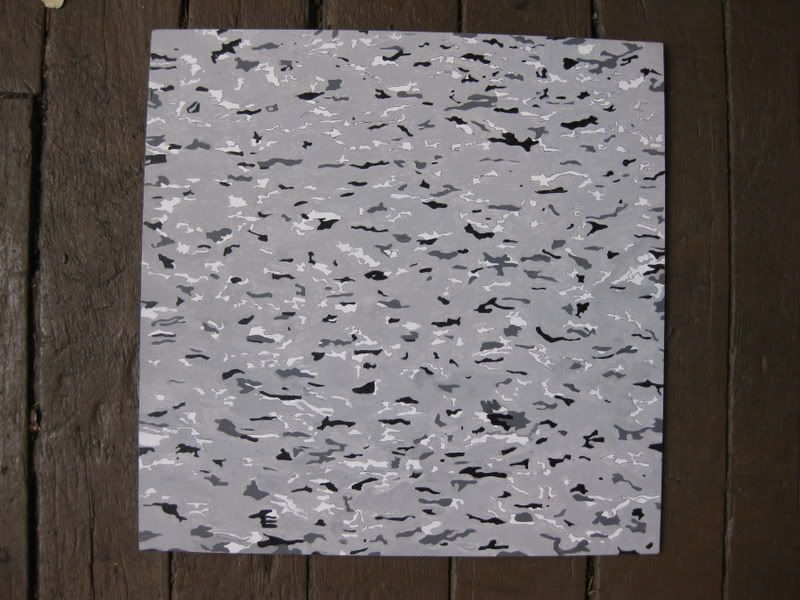
Here is a painting that I entered in the Exclamation Gallery's upcoming Superior Floor System show. All the paintings had to be on 12x12 inch floor tiles, and all the work will be installed as actual floor tiles and eventually destroyed when gallery guest walk on them.


The image on the linoleum tile is actually the image from another linoleum tile that I bought. I had originally intended to have two tiles and transfer each image onto the other tile, but (I think due to heat) the tiles would warp and bend during the process. So it wound up as just one, but I think it's still alright. I was intrigued by the idea of painting on a tile and wanted to get a bit into the idea of 'what is a tile?'. The purpose of this painting was to see if having this tile look like another tile would change it at all.